Last week we talked about rendering thousands of enemies without breaking a sweat. This week, we're talking about giving them somewhere to go.
Meet NeuStream — a world streaming runtime that lets Roblox developers build, generate, and stream massive game worlds that adapt to every device.
The Map Problem
If you've ever tried to build a large world in Roblox Studio, you know the pain. Place a few hundred parts — fine. A few thousand — Studio starts to groan. Tens of thousands — you're fighting the editor more than you're designing the game.
And that's just the authoring side. At runtime, loading an entire large map into memory at once is a non-starter on mobile. Players don't need to see terrain two kilometers away while they're fighting for survival in a canyon.
The traditional answer is manual streaming: hand-draw boundaries, write load/unload logic, test on every device, pray the edge cases don't break. It works, but it doesn't scale, and it certainly doesn't ship fast.
Why Not StreamingEnabled?
Roblox already has a streaming solution. StreamingEnabled lets the engine stream Instances to clients based on proximity. It's a reasonable default — and for many games, it's enough.
But it was designed for a different kind of game. Here's where it starts to strain:
The server does the work. With StreamingEnabled, the server decides what each client sees. It tracks every player's position, evaluates which Instances to send, and manages per-client streaming state. Ten players? Fine. Fifty players in a massive open world, each exploring different regions? That's fifty independent streaming controllers running on the server, each evaluating thousands of Instances. The cost scales with players times world complexity.
You stream what you built. StreamingEnabled streams Instances that already exist in the data model. That means every part, every model, every terrain segment lives on the server in memory — whether any player is near it or not. For hand-crafted maps, this is workable. For worlds that span thousands of studs with hundreds of landmarks, you're paying the full memory cost upfront, on every server.
Limited control over priority. When a player moves into a new area, StreamingEnabled decides what loads first. You can set StreamingPriority on individual model groups, but you can't say "load spawn points before decorations" or "skip cosmetics entirely on budget phones." The engine treats all geometry as geometry.
No adaptive quality. A high-end PC and a budget phone receive the same Instances. There's no built-in mechanism to reduce landmark density, simplify geometry, or skip decoration phases based on device capability. If the world is too dense for a phone, the phone just struggles.
No procedural generation pipeline. StreamingEnabled assumes a pre-authored world. If your map is procedurally generated — from a seed, a config file, or runtime parameters — you need to create all those Instances on the server first, then let the engine stream them. You're generating geometry just to serialize it over the network so clients can deserialize it. That's a round trip that doesn't need to exist.
NeuStream takes a fundamentally different approach. The server never holds geometry. It generates compact descriptors and publishes them once. Clients build their own geometry locally, loading only what's nearby, in priority order, at a quality level their hardware can sustain. The server cost per client is zero. The memory cost scales with what the player can see, not what the world contains.
It's not that StreamingEnabled is bad — it's that large-scale, procedural, performance-adaptive worlds need a different architecture.
What Is NeuStream?
NeuStream is a descriptor-driven world streaming runtime. Instead of placing thousands of Instances by hand, you describe what your world should look like — and NeuStream generates it, replicates it, and streams it to every client automatically.
The core idea is a three-phase pipeline:
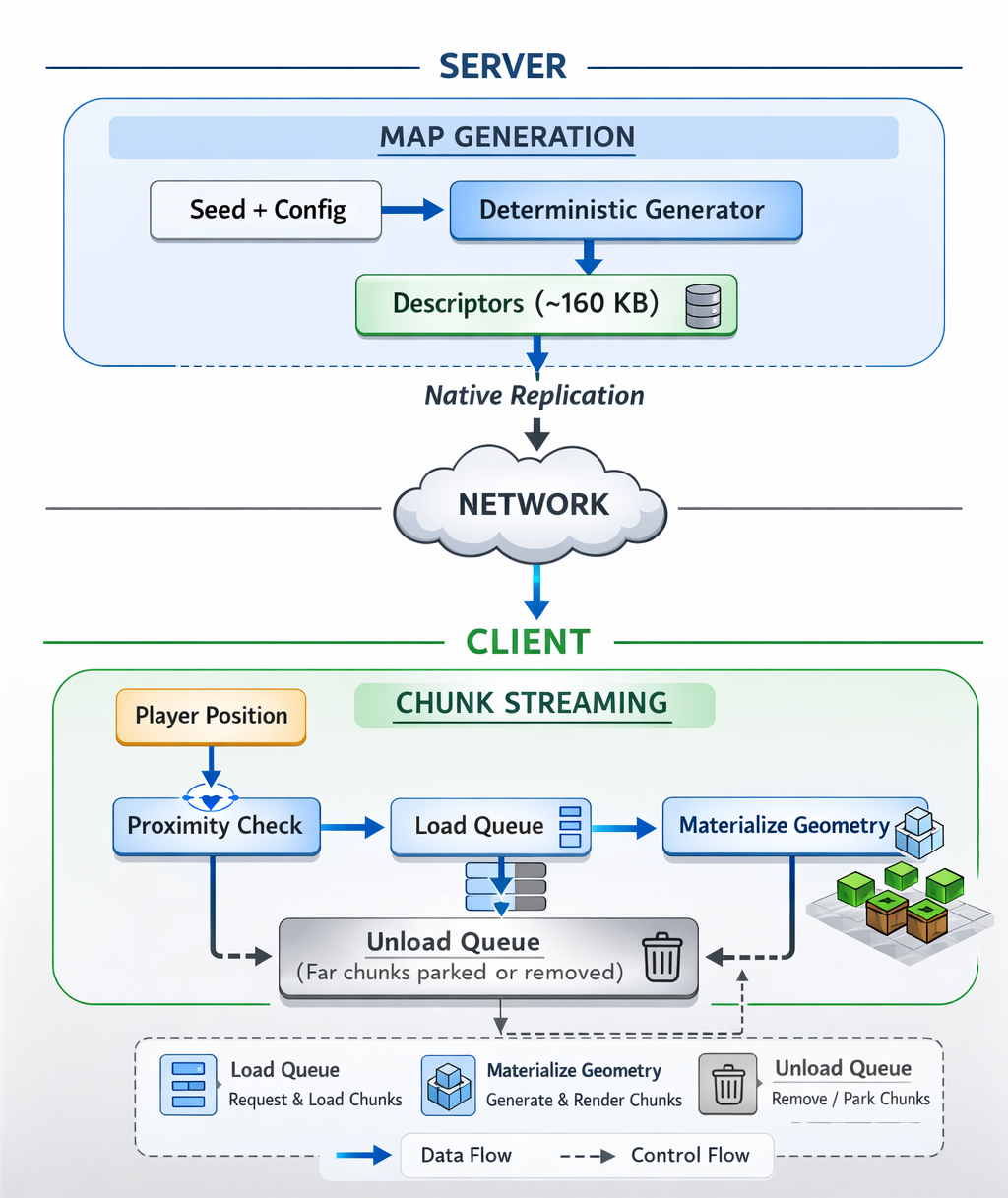
Generate the world deterministically on the server from a seed and configuration. Replicate lightweight descriptors — not geometry — to every client. Stream actual terrain and landmarks on each client based on player proximity and device capability.
The entire map description fits in roughly 160 kilobytes. The geometry is built locally, on demand, only where the player can see it.
Descriptors, Not Instances
This is the fundamental shift. Traditional Roblox maps are collections of Instances — parts, models, terrain — that exist in the data model and replicate to every client whether they need them or not.
NeuStream maps are descriptors: compact data that says "there's a rock formation at (1200, 0, -800), it's 40 studs wide, and it uses template 'BoulderCluster'". The server generates these descriptors once and publishes them. Clients read the descriptors and build actual geometry only for the chunks near the player.
The benefits cascade:
- No Instance limits during authoring — your map is a config, not a scene graph
- Minimal network cost — descriptors replicate once, not continuously
- Memory scales with visibility, not world size — only nearby chunks are materialized
- Deterministic regeneration — same seed, same world, every time
Chunks That Build Themselves
NeuStream divides the world into a grid of chunks. As the player moves, nearby chunks load and distant chunks unload. But loading isn't instant — it's progressive, spread across multiple frames to avoid hitches.
Each chunk builds in four phases:
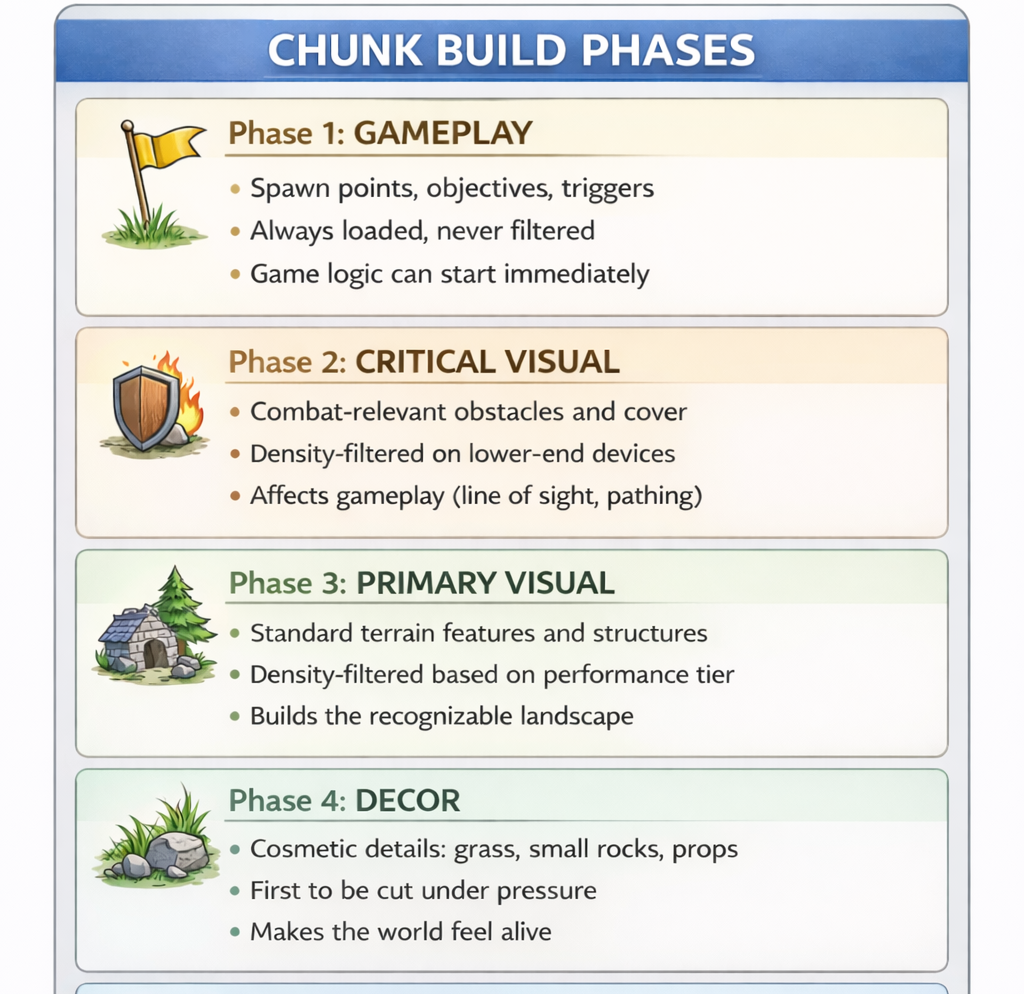
This phased approach means gameplay is never waiting on decoration. A budget phone might skip cosmetic details entirely, but spawn points and objectives are always there. The game works on every device — it just looks progressively richer on better hardware.
Smart Streaming, No Server Load
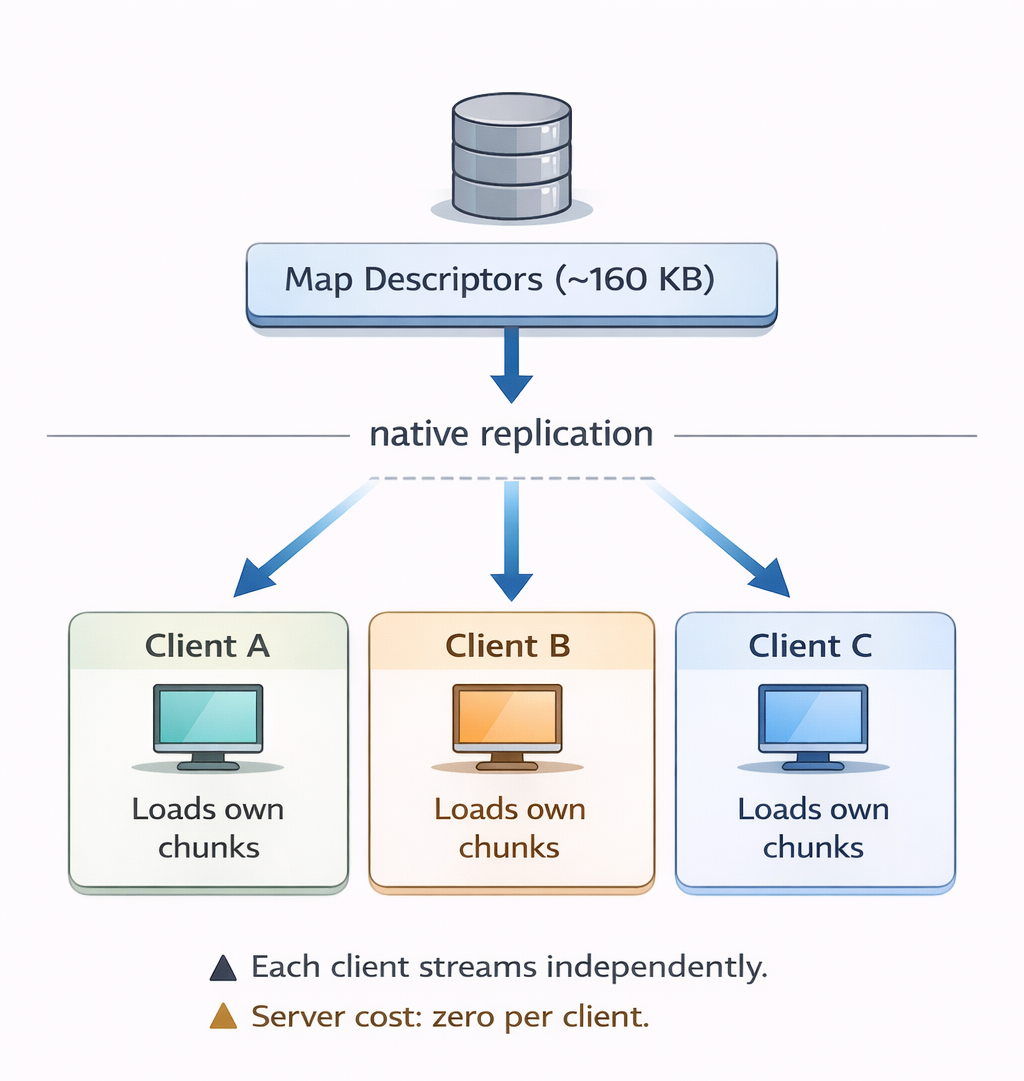
Here's something we're particularly proud of: the server doesn't manage per-client streaming state. It publishes descriptors once and is done. Each client autonomously decides what to load based on its own position and performance characteristics.
This means streaming cost on the server is effectively zero regardless of player count. Fifty players exploring different parts of the map? The server doesn't care — it already published the world description. Each client figures out its own viewport independently.
Adaptive Quality Across Devices
Like its sibling engine Swarmonics, NeuStream integrates with an adaptive performance system. When frame times rise, the streaming engine responds:
- Reduce landmark density — fewer decorative objects, keep gameplay-critical ones
- Simplify geometry — switch from full-detail to shell representations
- Adjust build budgets — spawn fewer parts per frame to keep the main thread breathing
- Manage chunk lifecycle — more aggressive unloading of distant areas
A high-end PC might render the full world in rich detail. A budget phone sees the same world with fewer decorative elements and simplified geometry — but the same gameplay spaces, the same landmarks that matter, the same navigable terrain.
Spatial Intelligence Built In
NeuStream isn't just a streaming engine — it's a spatial runtime. The server maintains a spatial index that game code can query:
- "What entities are within 200 studs of this position?" — for AI threat detection, loot proximity, event triggers
- "What are the 5 closest enemies to the player?" — sorted nearest-first, efficient even at scale
- Named zones with enter/exit callbacks — define regions like "Boss Arena" or "Safe Zone" and react when players cross boundaries
This turns the world from a passive backdrop into an active participant in gameplay. NPCs can reason about their surroundings. Events can trigger based on spatial relationships. Game designers can think in terms of regions and proximity instead of manual coordinate checks.
Runtime Control
Sometimes the world needs to respond to gameplay in real time. NeuStream supports runtime streaming directives — the server can force-load areas before players arrive:
-- Ensure the boss arena is fully loaded before the fight starts
NeuStreamService.LoadArea("BossArena", 3200, -1400, 900)
This is essential for scripted moments: boss encounters, story sequences, competitive arenas. The server says "this area matters right now" and every client loads it, regardless of proximity. When the moment passes, unload it and reclaim the resources.
Independence by Design
NeuStream was extracted from the Swarmonics engine as a standalone product. It doesn't require Swarmonics. It doesn't require any specific game framework. It's a self-contained world streaming runtime that works with any Roblox game architecture.
That said, when paired with Swarmonics, the two systems complement each other naturally. Swarms can use NeuStream's spatial queries for navigation. The world streams around players while thousands of enemies stream with it. The performance systems coordinate so neither engine starves the other.
But NeuStream stands on its own. If you need large-world streaming without swarm simulation, it's ready.
Why This Matters
We believe the next wave of Roblox experiences will be spatially ambitious. Open worlds where exploration is genuine. Survival games where the map feels vast and unpredictable. Competitive games where arena generation is dynamic and fair.
But ambition without infrastructure is just a wish list. NeuStream provides the infrastructure: deterministic generation, efficient streaming, adaptive quality, spatial reasoning — all in a runtime that costs the server effectively nothing per client.
Build worlds that feel limitless. Let the engine figure out how to fit them on every device.
NeuStream is developed by Neureal. It's available standalone or as a companion to Swarmonics.


