What if your players could face a tide of five thousand enemies rushing across the battlefield — and their phone didn't skip a beat?
That's the question we set out to answer when we started building Swarmonics.
The Problem No One Wants to Talk About
Roblox has an incredible runtime. Millions of players, cross-platform, instant join. But when it comes to rendering large numbers of AI-driven units — enemies, creatures, swarms — developers hit a wall fast.
Spawn 200 enemies with traditional approaches? Maybe fine. Spawn 2,000? Frame rates crater. Spawn 10,000? Good luck.
The bottlenecks are everywhere: server tick budgets explode with per-unit state, network bandwidth chokes on individual entity updates, and client rendering grinds to a halt trying to manage thousands of individual models. Developers end up choosing between ambition and performance — and performance usually wins.
We think that's the wrong tradeoff.
What Is Swarmonics?
Swarmonics is a server-authoritative swarm engine built for Roblox. It lets developers spawn, control, and render thousands of intelligent units while maintaining consistent frame rates — from high-end PCs all the way down to budget Android phones.
The key insight: not every unit needs to be a full citizen of the simulation. By treating groups of units as cohesive swarms rather than isolated individuals, we can make dramatically better decisions about what to compute, what to send over the network, and what to render.
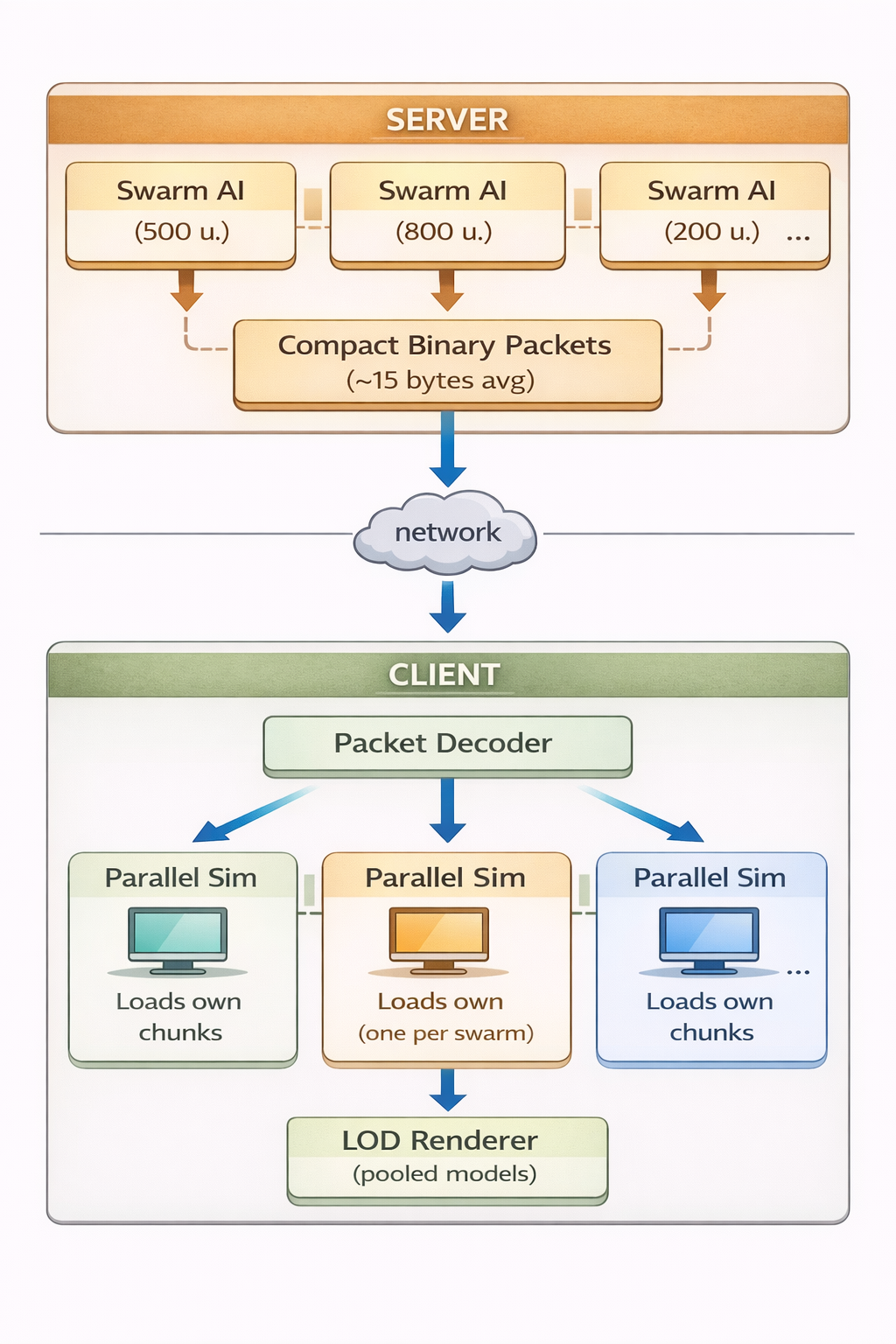
Server: Lean and Authoritative
The server owns everything — movement, targeting, combat, roster. But it doesn't create a single Instance per unit. Instead, it reasons about swarms as aggregate entities and encodes their state into compact binary packets.
The result? Processing 12,000 units costs roughly 1 millisecond per server tick. That leaves the rest of the frame budget entirely free for your game logic.
Because the server is authoritative, there's no risk of client-side exploitation. Players can't fabricate units, duplicate swarms, or fake damage. The server decides; the client visualizes.
Client: Parallel, Adaptive, Beautiful
On the client side, each swarm runs its own parallel simulation to determine where individual units should appear. This happens across multiple threads, keeping the main thread free for your UI, effects, and game systems.
But the real magic is in adaptive rendering. Swarmonics continuously monitors frame time pressure and adjusts what it renders:
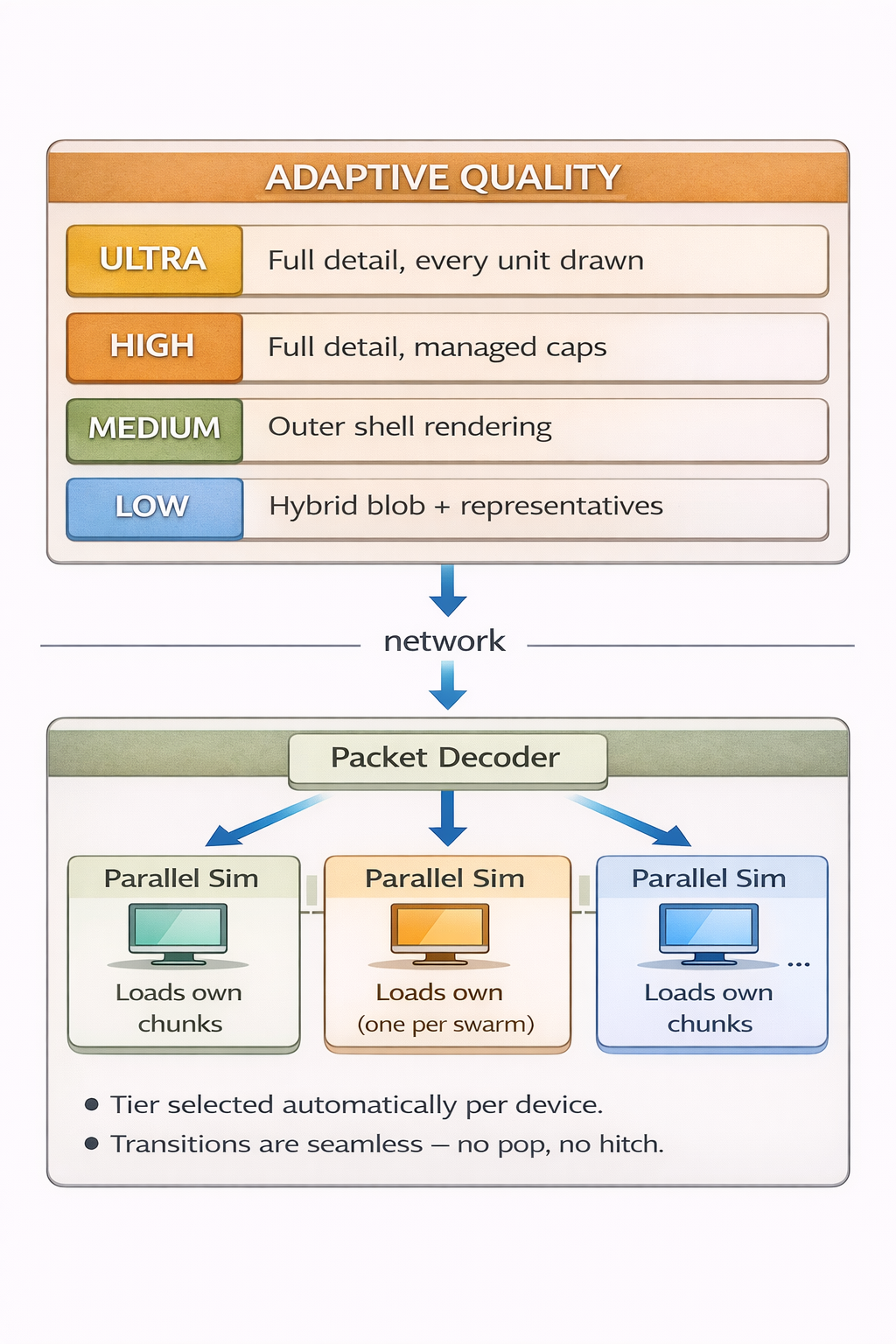
A high-end PC renders every unit individually. A budget phone shows the same swarm as a flowing mass with representative units at the edges. Same game. Same encounter. Same gameplay. Just a different level of visual fidelity — chosen automatically.
Distance-Based Intelligence
Not all swarms deserve equal attention. Swarmonics uses distance-based interest management to allocate resources where they matter most:
- Nearby swarms get frequent updates and full-detail rendering
- Mid-range swarms receive reduced update rates and simplified visuals
- Distant swarms get minimal updates and compact representations
- Out-of-range swarms go dormant — zero cost
This isn't just LOD. It's a unified system that scales network bandwidth, simulation fidelity, and render cost together. The swarm 50 studs from your player gets 10x the attention of one 500 studs away — because that's what matters for gameplay.
What Developers Actually See
We obsessed over the developer experience. Here's what it takes to add a swarm of 500 enemies to your game:
-- Register your enemy type (once)
SwarmService.RegisterEnemyTypes({ {
    name = "Zombie",
    templatePath = "Assets/Zombie",
    unitHp = 100,
    maxSpeed = 18,
    defaultCount = 500,
} })

-- Spawn a swarm
local swarmId = SwarmService.SpawnSwarmByName(
    Vector3.new(0, 5, 0), 500, "Zombie"
)

-- Point it at a player
SwarmService.SetSwarmTargetPlayer(swarmId, player)
That's it. No client code needed for basic rendering. No networking setup. No performance tuning. The engine handles everything.
Want hit effects? Subscribe to hit events on the client and spawn your VFX. Want swarms that split when damaged and reform when safe? Built in. Want custom AI behaviors? Plug into the state machine.
The Numbers
We test on the devices your players actually use.
| Budget Mobile | Mid-Range Mobile | PC | |
|---|---|---|---|
| Target FPS | 30 | 30 | 60 |
| Units on screen | Up to 3,000 | Up to 5,000 | Up to 12,000 |
| Server cost | ~1ms per tick | ~1ms per tick | ~1ms per tick |
Server cost stays flat because the architecture scales with swarm count, not unit count. Whether a swarm has 200 or 1,000 units, the server-side cost barely changes.
Swarms That Think
Every swarm runs a behavior state machine on the server:
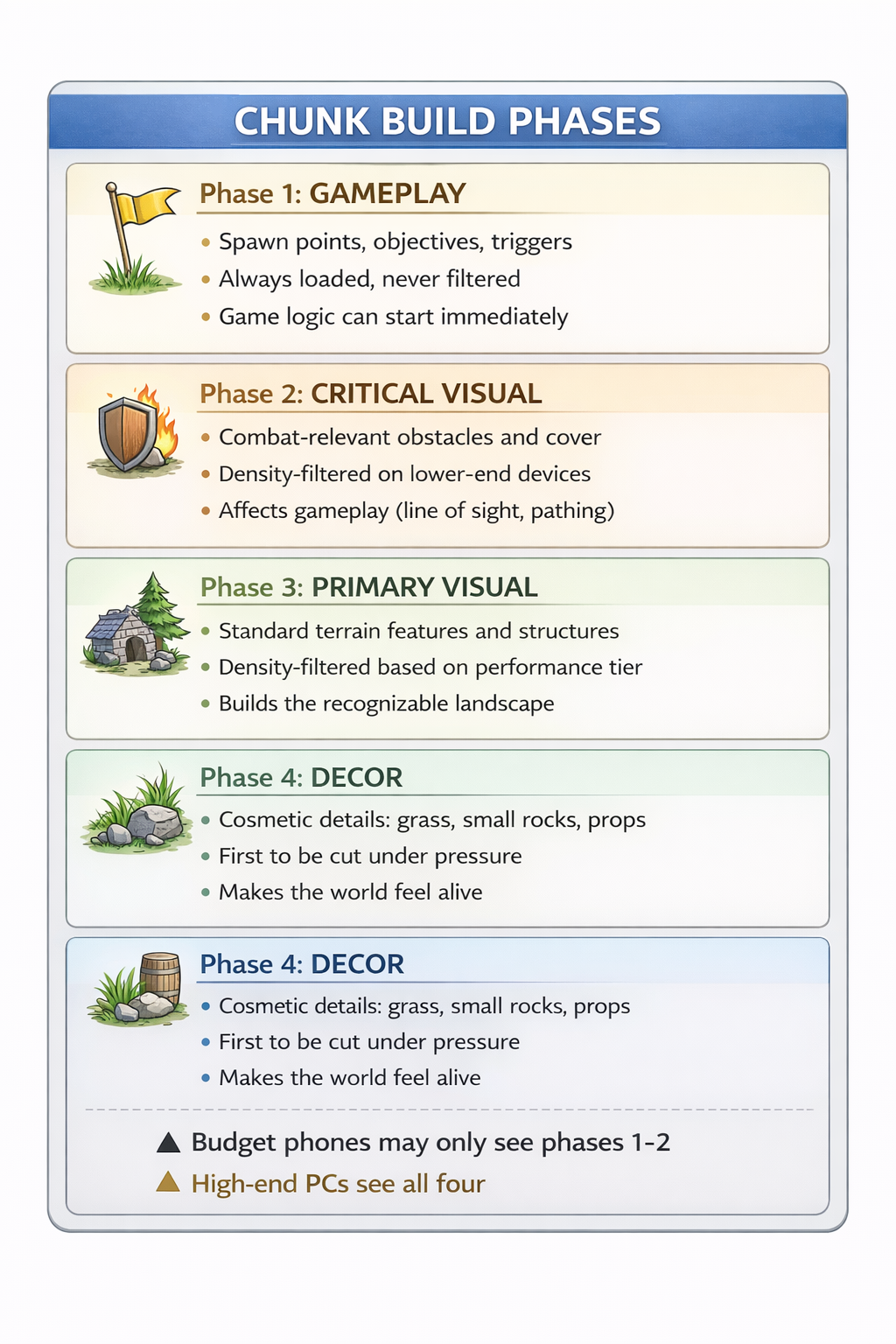
Swarms react to player proximity, chase targets, return to origin when targets are lost, and go dormant when no players are nearby. Developers can override behavior modes, set custom targets, or let the engine auto-manage — whatever fits the game.
Split, Merge, Evolve
Swarms aren't static blobs. They can split — units peel off to form a new group when the swarm takes damage or a designer triggers a division. They can merge — two groups recombine into one when conditions are right.
These transitions happen smoothly over multiple frames. No pop. No teleporting. The parent shrinks while the child emerges, or two groups flow together into one. It looks intentional because it is.
Why This Matters
We believe the next generation of Roblox games will be defined by scale and intelligence. Tower defense with actual hordes. Survival games where the threat is genuinely overwhelming. Action RPGs where you're not fighting six enemies in a room — you're fighting six hundred.
Swarmonics makes that possible today, on the devices players already own.
The engine handles the hard problems — networking, rendering, performance scaling, anti-cheat — so developers can focus on the fun problems: what does it feel like to face a living swarm? How does the player's strategy change when enemies number in the thousands? What new game designs become possible when scale is no longer the constraint?
We're excited to find out.
Swarmonics is developed by Neureal.


